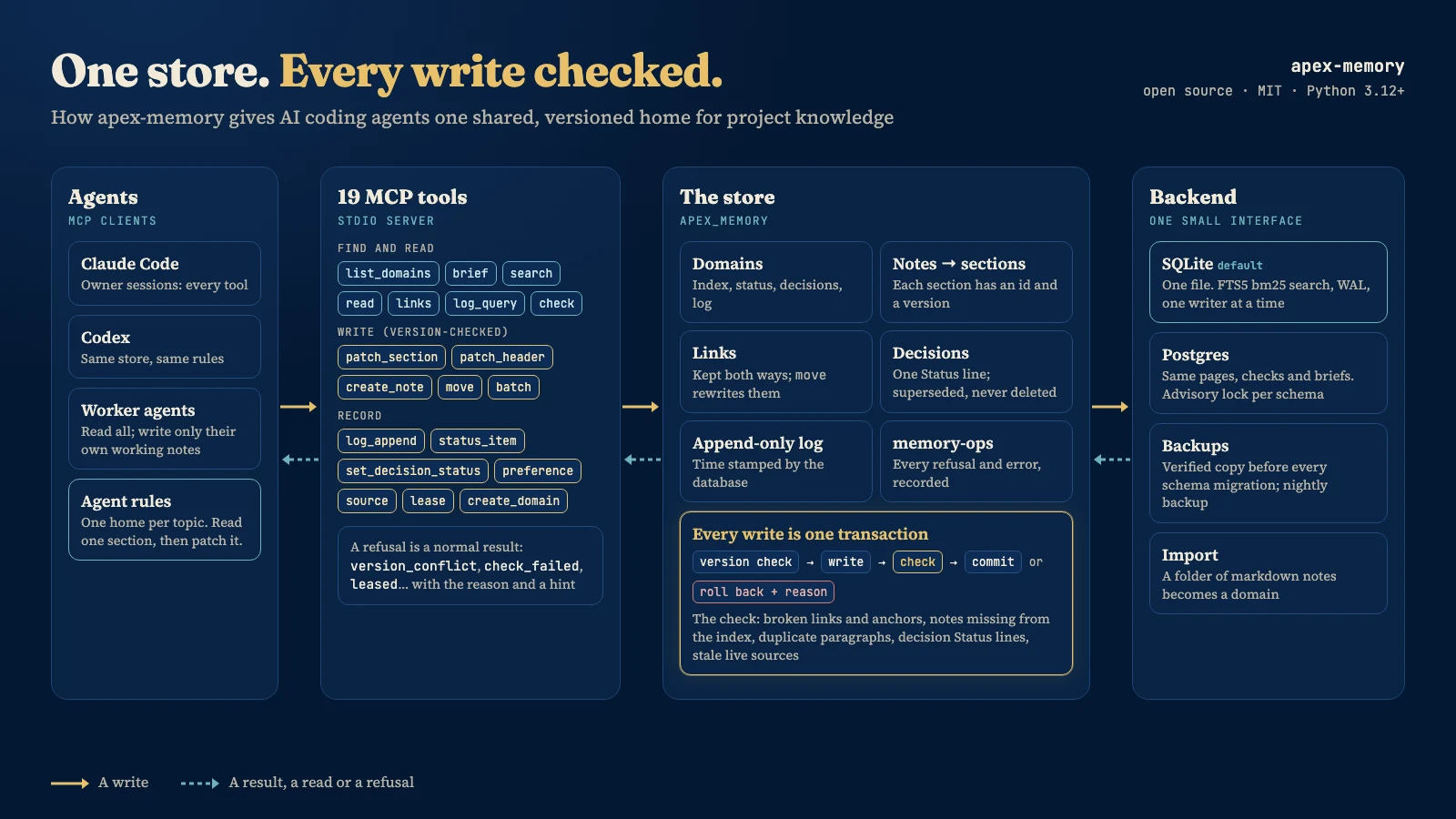
From mid-September 2026, my coding agents kept a client project’s decisions in an Obsidian vault reached over MCP: 50 notes, about 184,000 words and 281 log entries in four weeks. The method worked: corrections survived restarts, and every decision had one home. The tool did not.
- It was not always there. For one whole session the server pointed at the wrong vault, so nothing could be written.
- Updates were not atomic. Editing a note, updating the index and appending to the log were three writes, so an interrupted update left the vault half-changed.
- Search did not rank. It matched words without weighting them, so agents read files directly instead.
I kept the method and replaced the tool. apex-memory stores notes as sections with ids and versions. An agent reads one section and patches it with the version it read. Each write runs the check for broken links, notes missing from the index, duplicate paragraphs and malformed decision records. If the write adds a problem, it rolls back and the agent is told why. The log is append-only, and a decision is superseded, never deleted.
Every knowledge base moved in, and every refusal and error since then lands in a memory-ops domain. Its first 16 days held about 60 refusals and 17 agent reports, and they became v0.2.0: a batch tool, smarter checks and suggestions for headings that are not found. Then I moved the code out of a private project into its own MIT repository. There it sits behind a small Backend interface, with SQLite and Postgres passing the same tests.