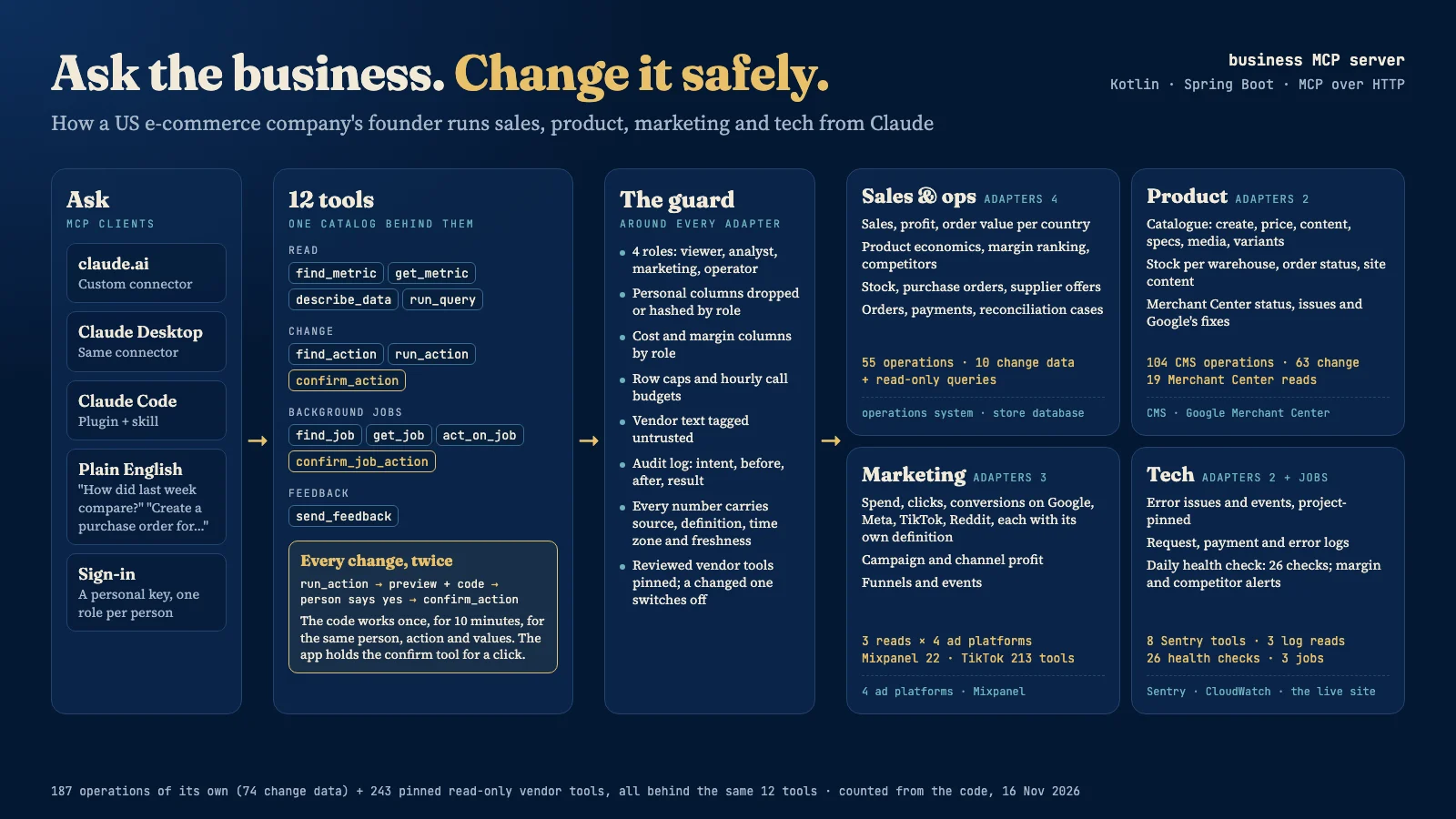
The founder ran the company from an internal operations dashboard, a CMS, Google Merchant Center, four ad platforms, Mixpanel and Sentry. A question such as “which campaigns made money last week?” meant opening several of them and matching definitions by hand, and some figures existed only in the dashboard’s browser code. Changes, from entering a purchase order to fixing a product’s Merchant Center data, went through screens or through the team.
What it does
The server lives inside the company’s operations backend and speaks MCP, so the founder adds it to claude.ai, Claude Desktop or Claude Code and signs in with a personal key. Then, by business area:
- Sales and operations: sales, gross profit and order value per country against last week; per-product economics and a margin ranking; stock, what is on order, purchase orders and supplier offers; orders and payments from the store’s database; refund, fraud and return cases.
- Product: the whole catalogue in the CMS (products, prices, content, specs, media, variants, FAQs, warranties, stock per warehouse, site content) and Merchant Center, including why a product is disapproved and Google’s own fix.
- Marketing: spend, clicks and conversions from Google, Meta, TikTok and Reddit, each with its own conversion definition; channel and campaign profit; Mixpanel funnels and events. The company’s agency has its own read-only role.
- Tech: Sentry issues and events, the store’s request, payment and error logs, and a daily health check of 26 checks over rendering, SEO, Merchant Center, catalogue content, payments and vendor changes.
How it’s built
Twelve tools sit in front of a searchable catalog. Claude searches with find_metric, then calls get_metric with one entry and only its declared parameters. For anything the catalog lacks, describe_data and run_query run one validated, read-only query. Every source is behind one adapter contract, so a new system is a new adapter, not a new tool. Each result carries its provenance: source, definition, time zone, currency and freshness. The server tells Claude never to recompute a figure or add up rows whose definitions differ.
A guard wraps every adapter and applies the person’s role: viewer, analyst, marketing or operator. Without the right permission, personal columns are dropped or hashed, and cost and margin columns are dropped. Only an operator can change data, and each change takes two calls. run_action returns the record before and after, any warnings and a one-time code, valid for ten minutes and bound to that person, action and values. confirm_action applies it in a later reply. Every call goes to an audit log with personal values hashed, and a change is refused if its intent cannot be recorded first. When an answer goes wrong, Claude logs it to a feedback store that only the owner reads.
Scripted Claude sessions for every role (60, then 14 more) found two personal-data leaks in payment log lines: a shipping name and billing addresses. I fixed both in the masker and checked them again.
How I built it
I designed it with the founder, then built the server and the store-side routes it writes through, end to end. I work with coding agents: Claude Code for the build, Codex for an independent review of each finished sub-feature.