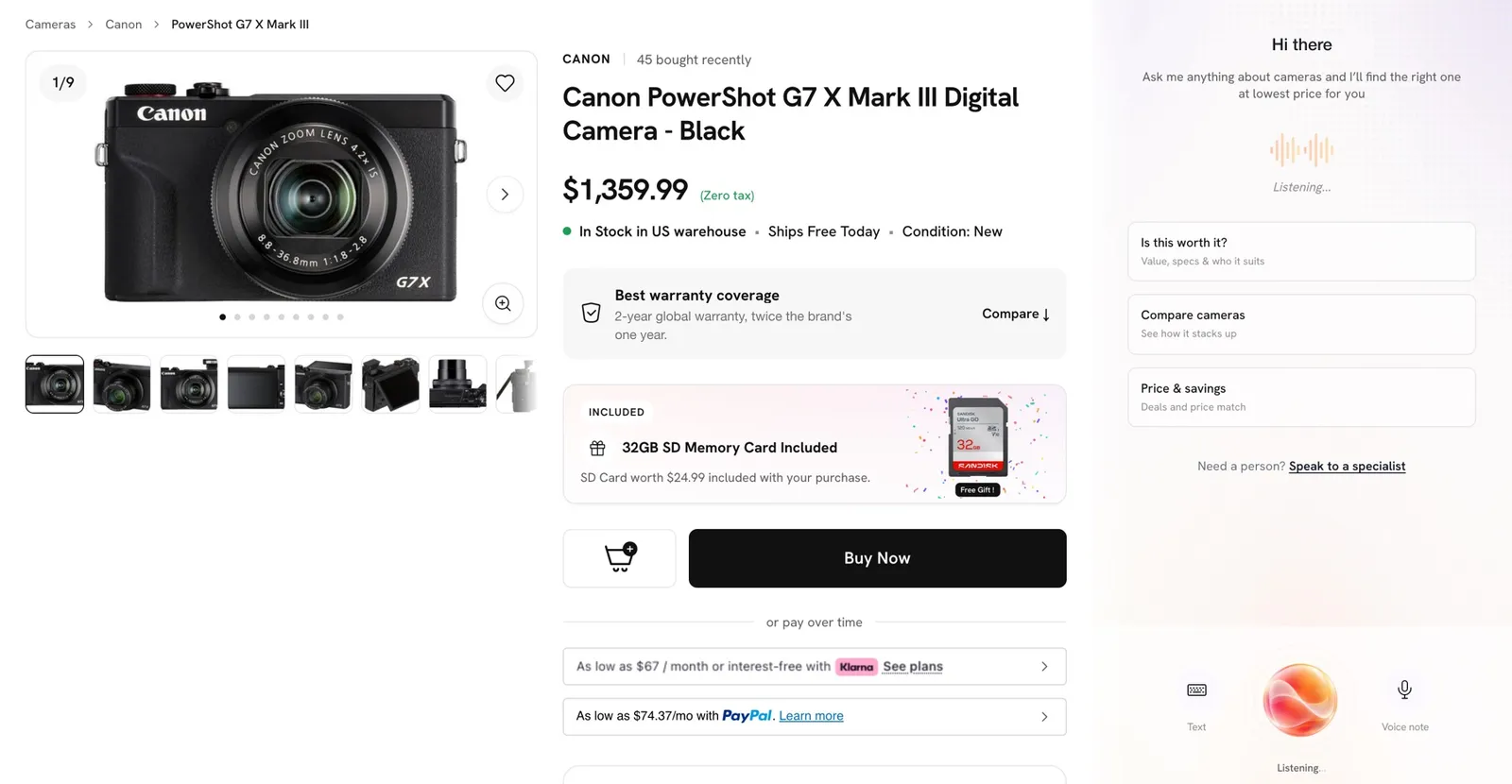
The assistant already ran on the store’s live site, answering by voice or text from the store’s product, stock, warranty and delivery data. But on desktop a full answer opened over the product page, so the shopper lost sight of the camera they were asking about. It had one voice mode: record, then send. And the website already worked out which group a shopper was in, from a first visit to a third visit with a camera in the cart, but the assistant ignored it.
What I rebuilt
I rebuilt it end to end, on the store’s live catalogue:
- A side rail, not a takeover. On desktop the page moves left and stays usable. On phones a sheet opens at half height, and the buy button stays visible.
- Three ways to talk. Hands-free is the default: the microphone opens with the rail, and a turn ends after 700 ms of silence. Text and voice notes with a live transcript are one tap away.
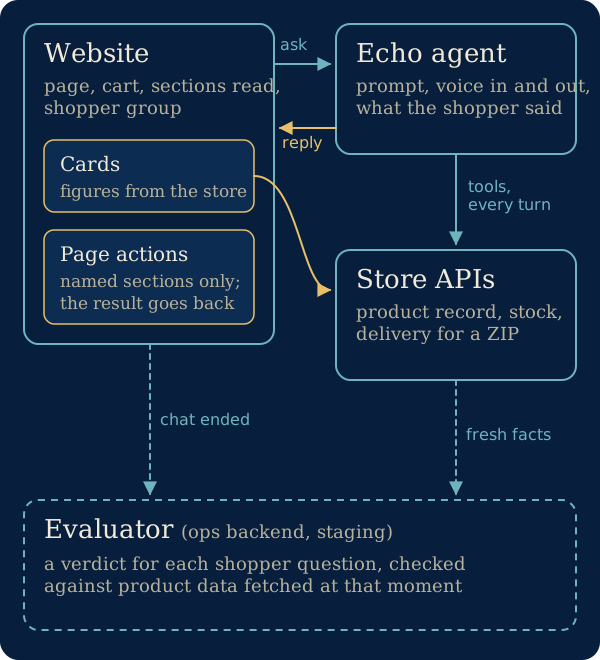
- Page actions. It opens a product, the home page, the camera list or the cart, and scrolls to 9 kinds of section, such as the warranty or what’s in the box.
- 12 answer cards, such as delivery, warranty, payment, comparison and fit.
- 9 nudges. At most 1 per page, and none after 3 are ignored in a visit.
- Replies by shopper group. The website recomputes one of 6 groups before every message.
How I built it
I wrote the agent’s prompts on Echo and tested every prompt change in loops. One loop found that an emptied cart was simply left out of the context, so the agent kept naming the last basket it had seen. Now an empty cart is sent as empty.
On the store I added the shopper context and instrumentation, a new visitor identity after 30 days without activity, and a fix so the assistant receives product IDs instead of warehouse codes.
For the insights dashboard I built the API and an evaluator. For each shopper question, a model gives a verdict, such as correct, partly or wrong, against product data fetched fresh.