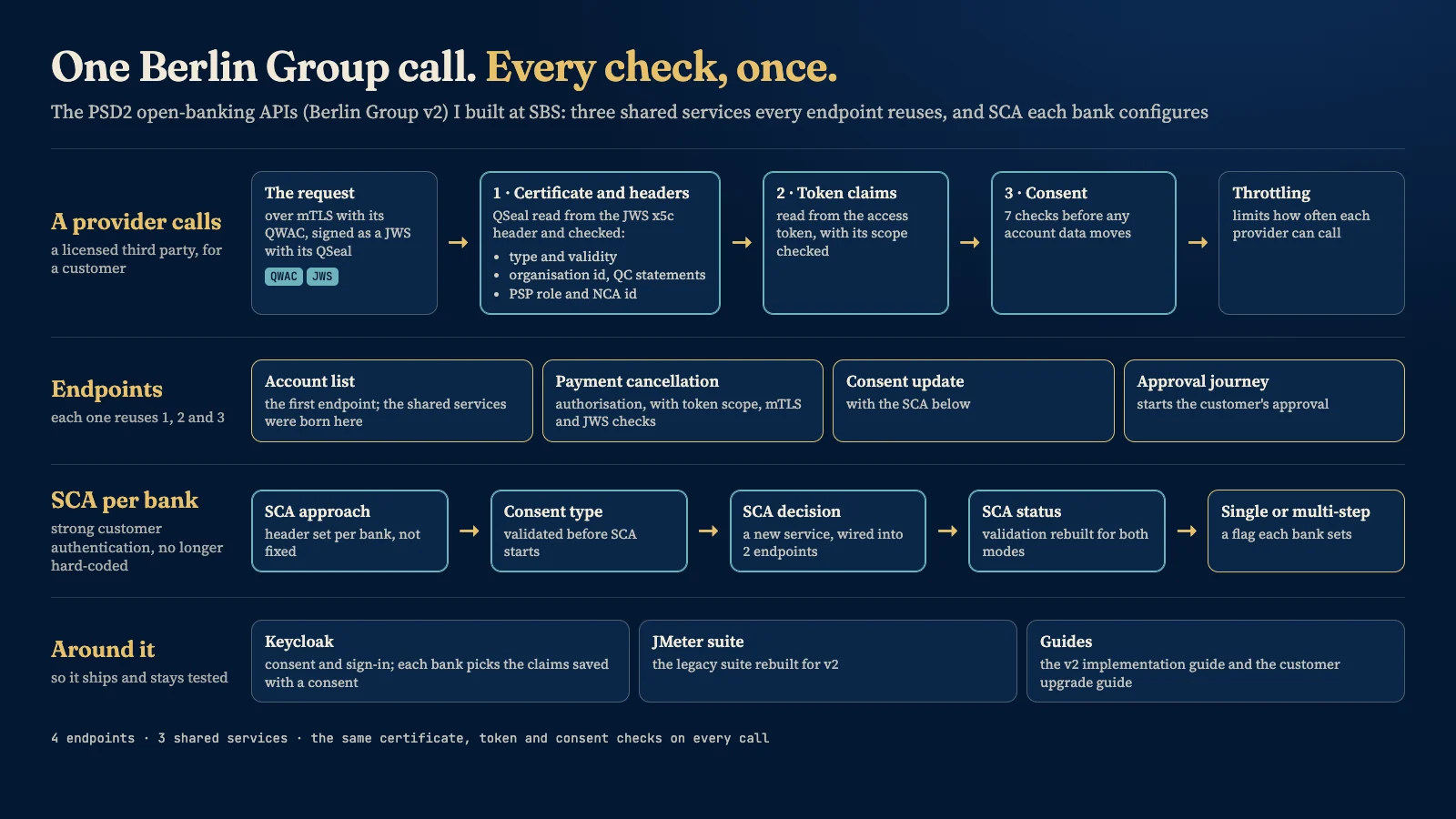
A third-party provider calls a bank’s API on a customer’s behalf. Before any data moves, the bank must know three things: the caller is a licensed provider with the right role, the access token covers this call, and the customer’s consent is valid for it. SBS was moving its client banks to version 2 of its Berlin Group APIs, and each check had to be built for it.
What I built
- The first endpoint, and the services under it. The account list was the first v2 endpoint, and the largest single piece of work. I built it on three shared services that every later endpoint reuses: certificate and header validation, token-claims extraction, and consent validation with seven checks. I added throttling, so each provider can call only so often.
- Payment-cancellation authorisation. A provider starts the customer’s approval to cancel a payment. It checks the token’s scope, the QWAC over mTLS and the JWS signature.
- SCA, the whole epic. Strong customer authentication in the consent flow was fixed to one approach. I made it per bank, single or multi-step, in five changes: the SCA-approach header, consent-type validation, a new SCA decision service wired into two endpoints, rebuilt SCA status validation, and a multi-step flag. The consent update and the approval journey run on it.
- Keycloak underneath. Consent and sign-in run on Keycloak with SBS’s extensions; I made the claims saved with a consent a per-bank setting. More on the Keycloak work.
Tested and written down
I rebuilt the legacy JMeter suite for v2, so every endpoint runs end to end with test certificates and signatures. I wrote the Berlin Group v2 implementation guide and the customer upgrade guide, and gathered the error codes, environment properties and features into one place.