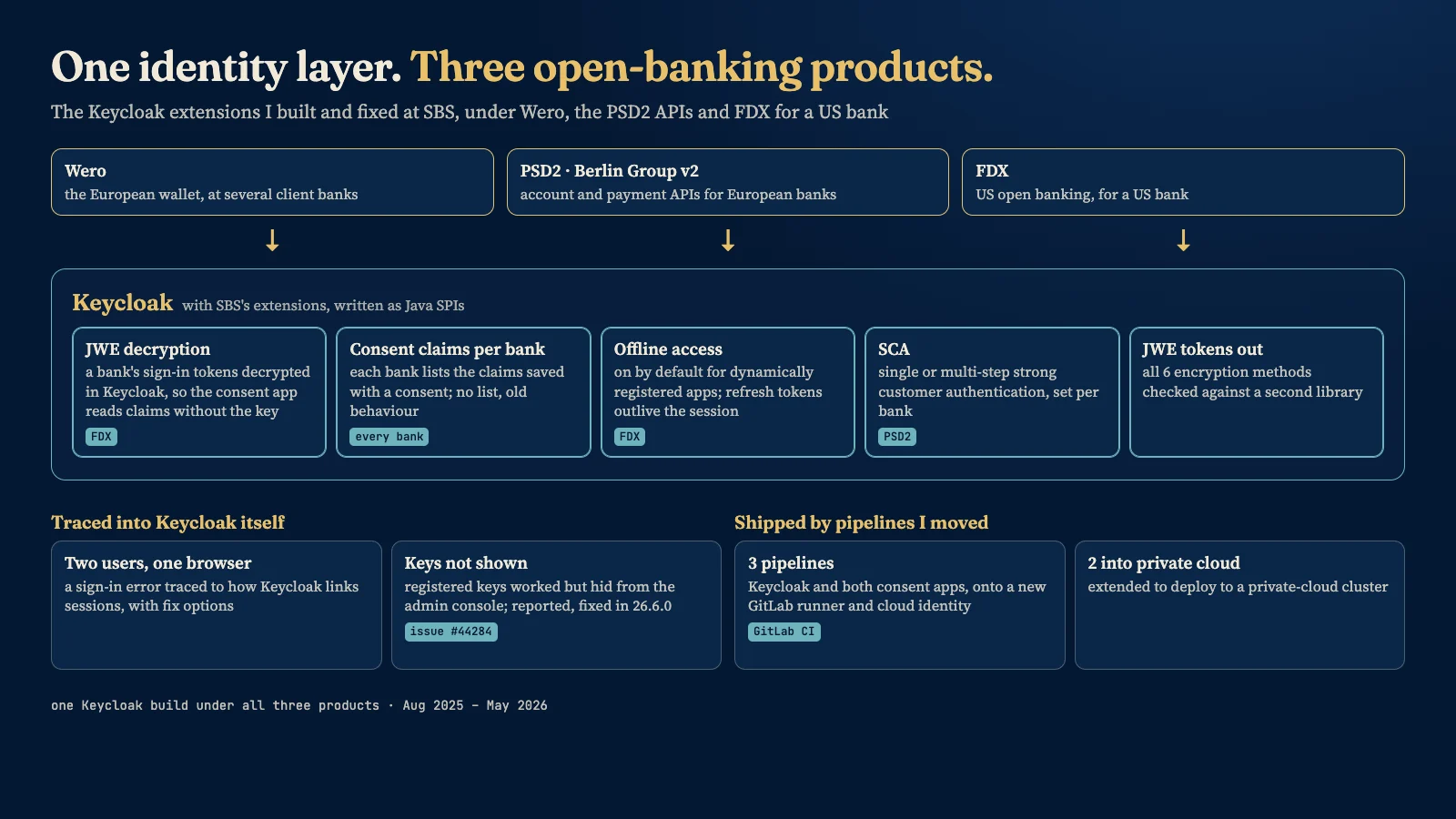
Every SBS open-banking product needs the same things from its identity layer. It signs a bank’s customers in, records what they consented to, and issues tokens that third-party apps can use and the APIs can trust. SBS runs Keycloak for this, with its own Java extensions (SPIs) for what Keycloak does not do out of the box. Each bank brings its own identity provider and its own rules, and the US bank on FDX brought the American standard’s.
FDX, for a US bank
- Offline access by default. Apps that register themselves through dynamic client registration now get offline access, so their refresh tokens no longer end with the sign-in session.
- A bank’s encrypted tokens. The bank’s identity provider sent JWE tokens. I extended our Keycloak extension to decrypt them and pass the signed token inside on, so the consent app reads the customer’s claims without holding the key.
- A registration case that kept failing. I traced it to Keycloak’s admin console: keys sent through dynamic client registration were stored and used, but not shown. I reported it to Keycloak, and the Keycloak team fixed it in 26.6.0.
- Two users, one browser. A sign-in error appeared when two customers signed in from the same browser. I traced it to how Keycloak links authentication sessions and set out the fix options.
Under all three
- Consent claims per bank. Each bank now lists which identity attributes are saved with a consent. There is no code change, and a bank without a list keeps the old behaviour.
- SCA. Strong customer authentication, single or multi-step per bank, which I built for the PSD2 APIs.
- Encrypted tokens out. When Keycloak gained JWE token generation, I checked it with all six symmetric encryption methods, decrypting every token with a second, independent library. I noted the gap that remained: asymmetric algorithms were not yet supported.
- Tenant realms. I moved four clients into the tenant realm template.
The pipelines behind it
I moved the deployment pipelines for Keycloak, the consent admin dashboard and the consent grant app to a new GitLab runner and cloud identity. Then I extended two of them to deploy to a private-cloud cluster.