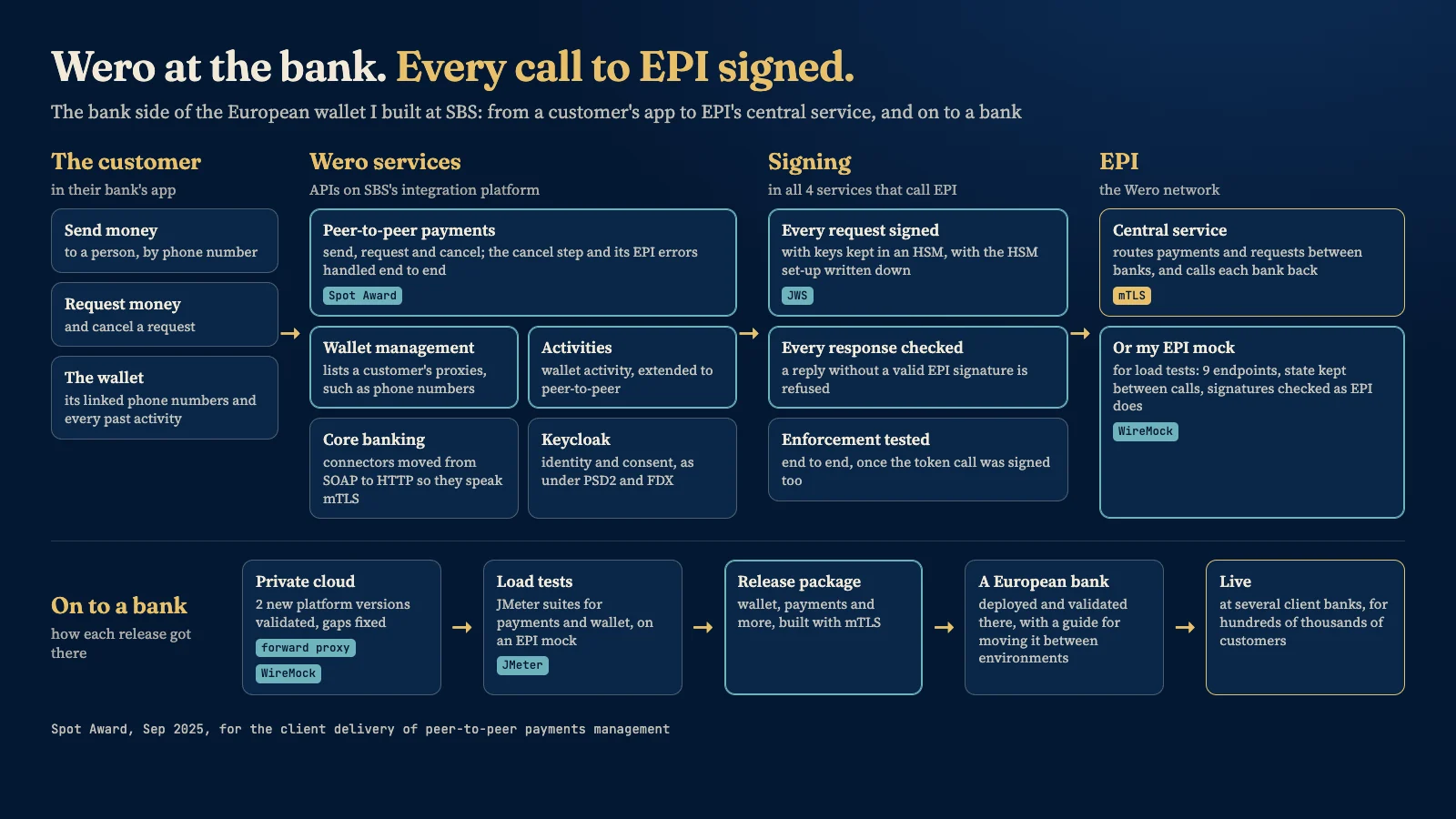
Wero lets a customer send money to a phone number, request money and see what moved, inside their own bank’s app. EPI runs the central service that routes payments between banks. Each bank needs its own side: APIs its app can call, connected to its core banking, signing every call to EPI and checking every reply. SBS builds that side for its client banks, and it was my main project for the whole year.
What I built
- Peer-to-peer payments. I built the step a payer uses to cancel a payment request: it checks that the request exists, calls EPI’s cancellation, and handles a missing request, EPI’s errors and refused calls. Through the first client delivery I worked on the whole peer-to-peer payments feature end to end, tested it with JMeter and fixed every bug the testing found, hotfixes included. That delivery earned me SBS’s Spot Award in September 2025.
- Wallet and activity. I built the APIs that list a wallet’s activity and a customer’s proxies, such as their phone numbers, then extended the activity list to peer-to-peer payments. I documented the filtering and paging defects I found in the upstream API they depend on.
- Signing. Every request the bank’s services send to EPI is signed with keys held in an HSM, and every response’s signature is checked. I added both to all four services that call EPI, wrote the HSM set-up, and tested enforcement end to end once the token call was signed too.
- mTLS to core banking. The connectors to the bank’s core banking used a SOAP client that could not do mTLS. I moved them to an HTTP client that handles the XML, with no change in what they do.
- Keycloak underneath. Identity and consent run on Keycloak with SBS’s extensions, the same layer under the PSD2 APIs and FDX. What I built in it.
How it reached a bank
I validated the product on two new versions of the integration platform in a private cloud. I set up a forward proxy and WireMock for the systems the cloud could not reach, then fixed the gaps the runs found. I kept the JMeter suites for payments and the wallet working, and built a mock of EPI’s central service so they could run without the live network.
Then I built the release package with mTLS, deployed it at a European bank and validated it there, OAuth connector set-up included. I wrote the guide for moving its projects from one environment to the next. The EPI mock got its own repository and CI pipeline.